> ## Documentation Index
> Fetch the complete documentation index at: https://docs.openhome.com/llms.txt
> Use this file to discover all available pages before exploring further.
# OpenHome Ability Templates
> Complete guide to OpenHome ability templates, architecture patterns, code snippets, and dashboard setup flow.
# OpenHome Ability Templates
> Five templates. Four ability categories. Unlimited possibilities.
OpenHome ability templates are starter blueprints. They are intentionally minimal and focused on runtime architecture, not polished UX.
## What OpenHome Actually Is
OpenHome runs AI agents that can trigger Python abilities. Those abilities can:
* control local tools through bridge methods
* call APIs and external services
* process ambient audio in loops
* store and share state over time
* run continuously as background daemons
LLMs are central in this model. They route, transform, and summarize, while abilities execute concrete actions.
## Ability Categories
| Category | Trigger | Lifecycle | Entry File |
| ----------------- | -------------------------- | -------------------------------------------- | --------------------------------- |
| Skill | User hotword | Runs once, exits | `main.py` |
| Agent Controlled | Agent routing | Runs on demand when the Agent delegates work | `main.py` |
| Background Daemon | Automatic on session start | Runs continuously until session end | `background.py` |
| Local | User hotword | Runs on-device with hardware access | `main.py` + `devkit_functions.py` |
Notes:
* Agent Controlled templates are still being finalized.
## Background Daemon Entry Contract
For daemon templates, `background.py` must be named exactly `background.py`.
```python theme={"system"}
def call(self, worker, background_daemon_mode: bool):
self.worker = worker
self.background_daemon_mode = background_daemon_mode
self.capability_worker = CapabilityWorker(self)
self.worker.session_tasks.create(self.background_loop())
```
## How To Use Templates In Dashboard
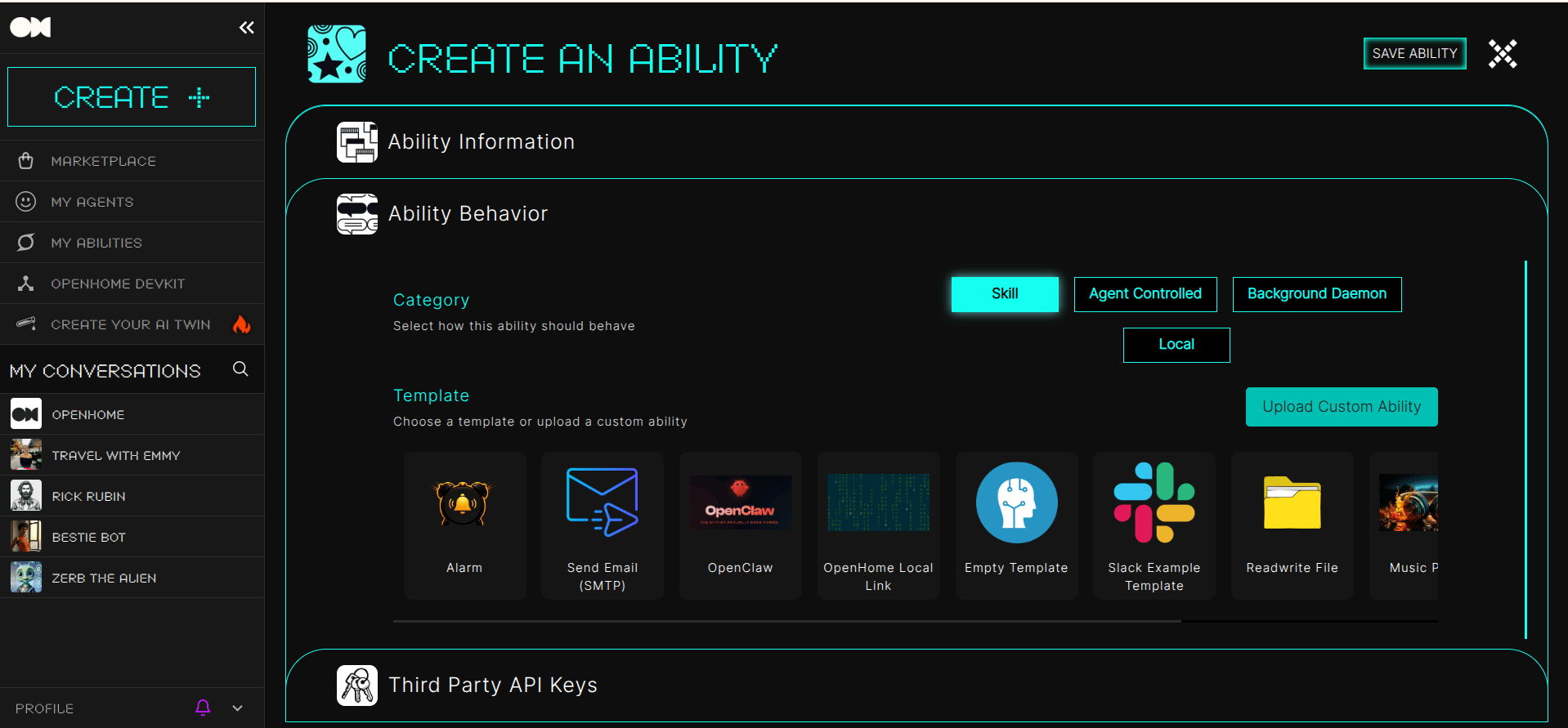
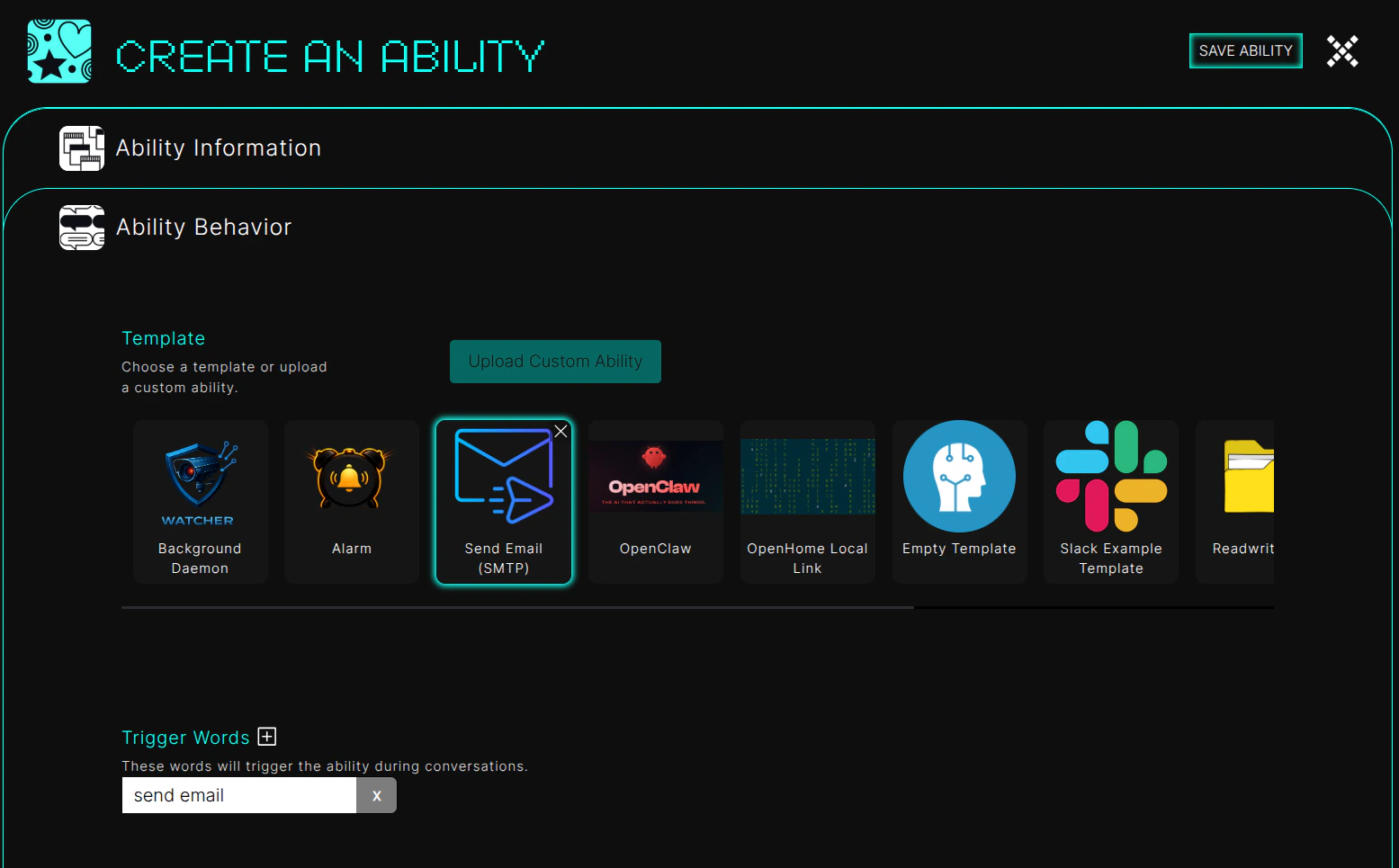
1. Click **Create** on `https://app.openhome.com/dashboard/home`.
2. Select **Agent Ability**.
3. Fill the **Create Ability** form and choose any category for your ability.
4. Fill **Ability Behavior**, then choose the template you want.
5. Click **Save Ability**.
## Template Directory
```text theme={"system"}
templates/
│
├── basic-template/ ← Minimal Skill skeleton
├── api-template/ ← Call an external REST API
├── loop-template/ ← Multi-turn looping Skill
│
├── SendEmail/ ← Fire-and-forget action
├── Local/ ← LLM-to-local-command translation
├── OpenClaw/ ← Route request to OpenClaw
│
├── Background/ ← Standalone background daemon
├── Alarm/ ← Skill + Background daemon combo
│
└── ReadWriteFile/ ← Shared file storage / IPC pattern
```
## Template README Sources
* [Alarm README](https://github.com/openhome-dev/abilities/blob/dev/templates/Alarm/README.md)
* [Local README](https://github.com/openhome-dev/abilities/blob/dev/templates/Local/README.md)
* [ReadWriteFile README](https://github.com/openhome-dev/abilities/blob/dev/templates/ReadWriteFile/README.md)
* [SendEmail README](https://github.com/openhome-dev/abilities/blob/dev/templates/SendEmail/README.md)
* [Background README](https://github.com/openhome-dev/abilities/blob/dev/templates/Background/README.md)
* [api-template README](https://github.com/openhome-dev/abilities/blob/dev/templates/api-template/README.md)
* [basic-template README](https://github.com/openhome-dev/abilities/blob/dev/templates/basic-template/README.md)
* [loop-template README](https://github.com/openhome-dev/abilities/blob/dev/templates/loop-template/README.md)
* [OpenClaw README](https://github.com/openhome-dev/abilities/blob/dev/templates/OpenClaw/README.md)
## Start Here Templates
### `basic-template` (Skill, minimal)
Purpose: absolute minimum lifecycle implementation.
```python theme={"system"}
async def run(self):
await self.capability_worker.speak("Hi! How can I help you today?")
user_input = await self.capability_worker.user_response()
response = self.capability_worker.text_to_text_response(
f"Give a short, helpful response to: {user_input}"
)
await self.capability_worker.run_io_loop(response + " Are you satisfied with the response?")
await self.capability_worker.speak("Thank you for using the advisor. Goodbye!")
self.capability_worker.resume_normal_flow()
```
### `api-template` (Skill, external API)
Purpose: ask user input, call API, summarize result, exit cleanly.
```python theme={"system"}
async def run(self):
await self.capability_worker.speak("Sure! What would you like me to look up?")
user_input = await self.capability_worker.user_response()
result = await self.fetch_data(user_input)
if result:
spoken = self.capability_worker.text_to_text_response(
f"Summarize this data in one short sentence for voice: {result}"
)
await self.capability_worker.speak(spoken)
else:
await self.capability_worker.speak("Sorry, I couldn't get that information right now.")
self.capability_worker.resume_normal_flow()
```
### `loop-template` (Skill, long-running loop)
Purpose: interactive multi-turn skill with explicit exit words.
```python theme={"system"}
EXIT_WORDS = {"stop", "exit", "quit", "done", "cancel", "bye", "goodbye", "leave"}
async def run(self):
await self.capability_worker.speak("I'm ready to help. Ask me anything, or say stop.")
while True:
user_input = await self.capability_worker.user_response()
if not user_input:
continue
if any(word in user_input.lower() for word in EXIT_WORDS):
await self.capability_worker.speak("Goodbye!")
break
response = self.capability_worker.text_to_text_response(
f"Respond in one short sentence: {user_input}"
)
await self.capability_worker.speak(response)
self.capability_worker.resume_normal_flow()
```
## The Five Core Templates
### 1. `SendEmail` (Skill · Fire-and-forget)
What it demonstrates:
* one trigger, one action, one status response
* synchronous SDK call in async flow
* required handoff to `resume_normal_flow()`
```python theme={"system"}
async def email_sender(self):
status = self.capability_worker.send_email(
host="smtp.gmail.com",
port=465,
sender_email="test@gmail.com",
sender_password="app-password",
receiver_email="receiver_test@gmail.com",
cc_emails=[],
subject="Test Email",
body="Hello from OpenHome!",
attachment_paths=["testfile.txt"],
)
await self.capability_worker.speak(
"Email has been sent successfully." if status else "Failed to send email"
)
self.capability_worker.resume_normal_flow()
```
Production upgrades:
* collect recipient/body from user, do not hardcode
* add confirmation step before send
* secure credential handling
### 2. `OpenHome-local` (Skill · LLM-as-translator)
What it demonstrates:
* user speech to terminal command generation
* local execution bridge with `exec_local_command()`
* second LLM pass to explain execution result
```python theme={"system"}
user_inquiry = await self.capability_worker.wait_for_complete_transcription()
terminal_command = self.capability_worker.text_to_text_response(
user_inquiry, [], self.get_system_prompt()
).strip()
await self.capability_worker.speak(f"Running command: {terminal_command}")
response = await self.capability_worker.exec_local_command(terminal_command)
result = self.capability_worker.text_to_text_response(
f"check if the command successfully ran? response is: {response}",
[{"role": "user", "content": user_inquiry}],
"Explain success/failure in simple spoken language.",
)
await self.capability_worker.speak(result)
self.capability_worker.resume_normal_flow()
```
Production upgrades:
* command allowlist / denylist
* confirmation before high-risk commands
* timeout and error boundaries
### 3. `openclaw-template` (Skill · Sandbox escape)
What it demonstrates:
* pass-through request routing to OpenClaw
* no terminal generation layer, direct local AI routing
```python theme={"system"}
user_inquiry = await self.capability_worker.wait_for_complete_transcription()
await self.capability_worker.speak("Sending Inquiry to OpenClaw")
response = await self.capability_worker.exec_local_command(user_inquiry)
await self.capability_worker.speak(response["data"])
self.capability_worker.resume_normal_flow()
```
Production upgrades:
* robust response validation
* fallback for unmatched tools
* timeout + retry strategy
### 4. `Background` + `Alarm` (Background daemon pattern)
What it demonstrates:
* continuous background loop with `session_tasks.sleep()`
* reading session history / file state periodically
* skill + daemon coordination through shared storage
Background loop pattern:
```python theme={"system"}
async def first_function(self):
while True:
history = self.capability_worker.get_full_message_history()[-10:]
for message in history:
self.worker.editor_logging_handler.info(
f"Role: {message.get('role','')}, Message: {message.get('content','')}"
)
await self.worker.session_tasks.sleep(20.0)
```
Alarm background fire pattern:
```python theme={"system"}
if now >= target_dt:
await self.capability_worker.send_interrupt_signal()
await self.capability_worker.play_from_audio_file("alarm.mp3")
await self._mark_alarm_triggered(alarms, alarm_id)
```
Critical daemon rules:
* use `session_tasks.sleep()`, not `asyncio.sleep()`
* do not call `resume_normal_flow()` in daemon loops
* interrupt before daemon speech/audio when needed
* persist JSON safely (see `ReadWriteFile` rules)
* background file name must be exactly `background.py`
### 5. `loop-template` a.k.a. Log-My-Life pattern (Skill · Ambient observer)
What it demonstrates:
* long-running session loop
* periodic capture/process/respond
* explicit phrase-based exit
Core ambient loop shape:
```python theme={"system"}
while self.is_running:
self.capability_worker.start_audio_recording()
exit_requested = await self.wait_for_interval_or_exit()
self.capability_worker.stop_audio_recording()
audio_bytes = self.capability_worker.get_audio_recording()
await self.process_chunk(audio_bytes, recording_length)
if exit_requested:
self.is_running = False
```
Important audio detail:
* `get_audio_recording()` may return cumulative recording data.
* If chunking externally, track prior byte offset and slice new data before transcription/analysis.
## Utility Pattern: `ReadWriteFile`
Purpose: safe shared-state and IPC pattern across Skill and Daemon.
```python theme={"system"}
if await self.capability_worker.check_if_file_exists("temp_data.txt", in_ability_directory=False):
await self.capability_worker.write_file(
"temp_data.txt",
f"\n{time()}: {user_response}",
in_ability_directory=False
)
else:
await self.capability_worker.write_file(
"temp_data.txt",
f"{time()}: {user_response}",
in_ability_directory=False
)
file_data = await self.capability_worker.read_file("temp_data.txt", in_ability_directory=False)
```
For JSON files:
* always use delete-then-write when replacing full file content
* append mode is still good for `.txt` and `.log` activity streams
## Utility Pattern: `.md` Context Injection
Purpose: feed ambient context into the Agent prompt through persistent markdown files.
```python theme={"system"}
content = "## Emotional State\n- Current: frustrated (confidence: 0.87)\n"
exists = await self.capability_worker.check_if_file_exists("audio_emotion.md", in_ability_directory=False)
if exists:
await self.capability_worker.delete_file("audio_emotion.md", in_ability_directory=False)
await self.capability_worker.write_file("audio_emotion.md", content, in_ability_directory=False)
```
Rules:
* only persistent `.md` files are injected into Agent context
* reserve `user_profile.md` and `user_summary.md` for platform memory background ownership
* keep each injected `.md` file short and current-state focused
* expect \~60-90 seconds before a newly written `.md` file is reflected in responses
See: [Agent Memory & Context Injection](/agent_memory_context_injection)
## Utility Pattern: Key-Value Context Storage
Purpose: structured state for preferences, conversation workflows, feature flags, and cache metadata.
Notes:
* Key-value methods are synchronous (do not `await`).
* Store JSON dictionaries (`dict`) as values.
```python theme={"system"}
existing = self.capability_worker.get_single_key("conversation_456_state")
if existing:
self.capability_worker.update_key(
"conversation_456_state",
{"step": "confirmed", "intent": "book_flight", "destination": "Dubai"},
)
else:
self.capability_worker.create_key(
"conversation_456_state",
{"step": "awaiting_confirmation", "intent": "book_flight", "destination": "Dubai"},
)
```
Related methods:
* `create_key(key, value)`
* `update_key(key, value)`
* `delete_key(key)`
* `get_all_keys()`
* `get_single_key(key)`
* missing-key-safe pattern: read with `get_single_key()` before `update_key()`, create when absent
## How Templates Map To Ability Types
| Template | Type | Key SDK Methods |
| ------------------- | -------------------- | ----------------------------------------------------------------------------------------------------------- |
| `SendEmail` | Skill | `send_email()`, `speak()`, `resume_normal_flow()` |
| `OpenHome-local` | Skill | `wait_for_complete_transcription()`, `text_to_text_response()`, `exec_local_command()` |
| `openclaw-template` | Skill | `wait_for_complete_transcription()`, `exec_local_command()`, `speak()` |
| `Background` | Background Daemon | `get_full_message_history()`, `session_tasks.sleep()` |
| `Alarm` | Skill + Daemon | `read_file()`, `write_file()`, `send_interrupt_signal()`, `play_from_audio_file()`, `session_tasks.sleep()` |
| `loop-template` | Skill (long-running) | `start_audio_recording()`, `stop_audio_recording()`, `get_audio_recording()`, `text_to_text_response()` |
| `ReadWriteFile` | Utility / IPC | `check_if_file_exists()`, `read_file()`, `write_file()`, `delete_file()` |
| `Context Storage` | Utility / State | `create_key()`, `update_key()`, `get_single_key()`, `get_all_keys()`, `delete_key()` |
| `basic-template` | Skill | `speak()`, `user_response()`, `run_io_loop()`, `resume_normal_flow()` |
| `api-template` | Skill | `user_response()`, `text_to_text_response()`, `resume_normal_flow()` |
## Critical Technical Rules
| Rule | Why |
| ------------------------------------------------------------------- | ----------------------------------------------------------------------- |
| Call `resume_normal_flow()` on every Skill exit path | Returns control to the main agent flow |
| Do not use `resume_normal_flow()` inside daemon loops | Daemons are independent long-running tasks |
| Use `call(self, worker, background_daemon_mode)` in `background.py` | Ensures daemon startup contract is correct |
| Prefer `session_tasks.sleep()` over `asyncio.sleep()` | Ensures proper cleanup on session end |
| Treat JSON writes carefully | Default `write_file` mode appends and can corrupt JSON |
| Use persistent `.md` files for ambient prompt context | Memory background injects user-level markdown into Agent prompt |
| Use key-value context storage for structured state | `create_key`/`update_key`/`get_single_key` reduce JSON file bookkeeping |
| Validate local command execution | Prevent unsafe/destructive operations |
## What You Can Build From These
* voice-composed email flows
* local machine operator abilities
* OpenClaw orchestration flows
* background profilers, summarizers, and schedulers
* ambient capture and extraction assistants
These templates are the foundation layer. Start with the closest pattern, keep lifecycle rules strict, and then harden for production.
***