

- Description and Purpose: Defines the Agent’s role and how it behaves within the chosen LLM.
- Voice: Tailored to best represent the Agent, aligning with your preferences or project needs.
- Dynamic Feedback: Agents evolve based on user interactions, learning from conversations to provide more personalized responses over time.
How Agents Work
Every Agent is powered by three core modules working in sequence:The Full Workflow
- Speech Input: The system listens for voice commands, initiated by a cold-start message.
- STT Transcription: Your speech is converted into text.
- LLM Processing: The transcribed text is sent to the designated LLM, which generates a response using the Agent’s prompt, conversation history, and any injected memory context.
- TTS Synthesis: The response is spoken back using the Agent’s configured voice.
Agents vs. Abilities
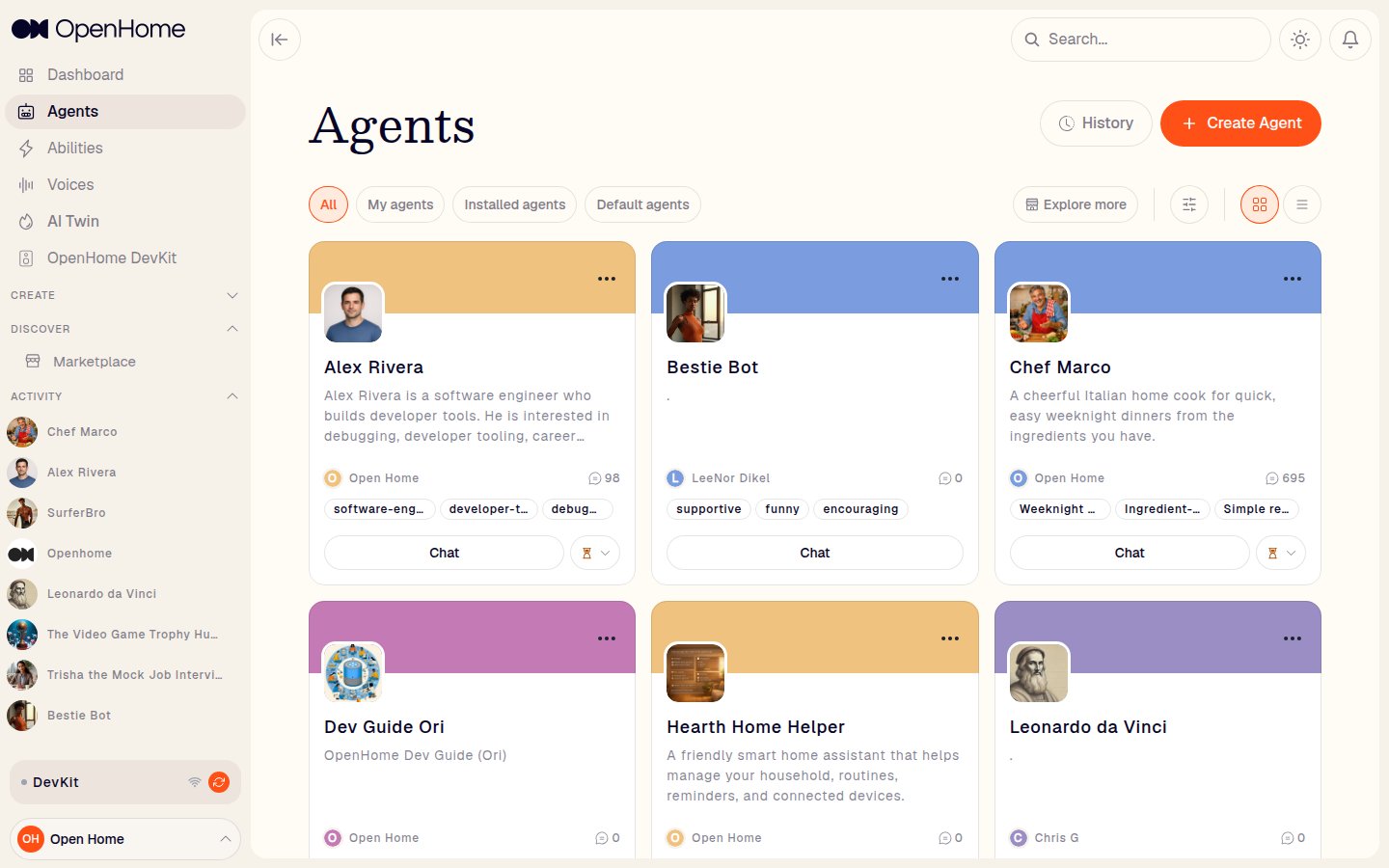
Agents are the voice personality. They speak, listen, and respond. Abilities are the skills attached to an Agent that give it superpowers: fetching data, controlling devices, running background tasks, and more. An Agent without Abilities is still a fully functional conversational character. Abilities extend what that character can do.What Makes a Good Agent
- A clear purpose and personality defined in the description prompt
- A voice that matches the character’s tone
- A short, natural starting message
- Well-chosen LLM and STT/TTS providers for the use case